
I’m not a fan of Chat GBT or other Chatbots. Granted, they can be helpful for finding available flights, creating a trip itinerary, figuring out how to fit all your worldly possessions into a three hundred square foot room, or speeding up a patient’s screening process. But…
Where I have issues is how quickly people rely on AI to do everything for them, allowing AI to rob us of our creativity, reflection, ability to appreciate beauty and develop our morality and character. All these things take time, and that is the very thing AI wants to “save” us from.[1] The problem with this is not that AI is becoming more human, but that we are turning into robots.
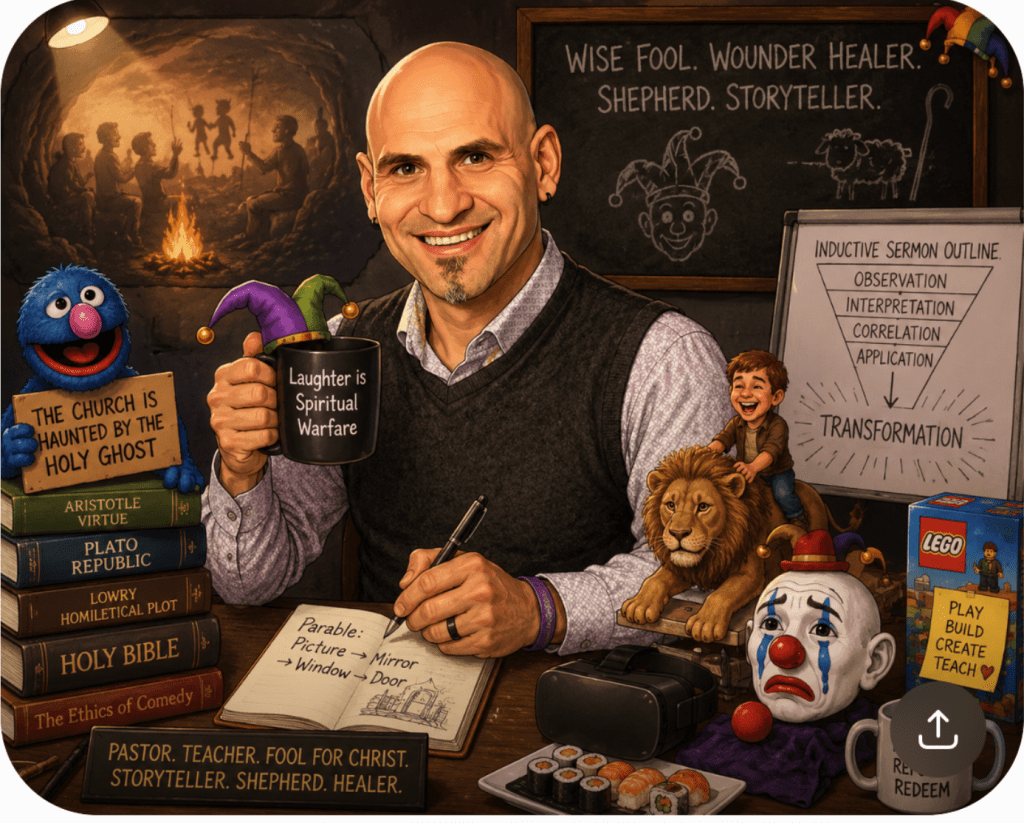
However, when I opened my phone today, and Chat GPT sent me an ad, I got sucked in. I almost never click on ads, or even look at them, but this one caught my attention. The ad had taken my profile picture off the school website where I work and said to click here to, “Create a caricature of me and my job on everything you “know” about me.”[2] So, intrigued, I clicked. Thirty seconds later it spat back the picture I have attached to this article. And I will admit to not only being impressed with the result, but happy to be known by the things illustrated in this image.
As you look at the picture, you’ll be able to tell that I am a Christian, a pastor, a teacher, a preacher and married.[3] You’d also perceive that I value comedy, laughter and play, and see these as important elements of my faith.[4] The picture also includes C.S. Lewis’s Narnia, Plato’s cave, and a quote from a recent sermon I gave on Jesus calming the storm.[5] Impressively, it even included my favorite Sesame Street character, Grover.[6]
Reflecting on the profile image got me thinking about you. What would your online profile picture look like? What would it say about you if it gathered all your online information? How accurately would it reflect who you are offline?
For many, the danger of the internet is that it allows them to hide their identity, or create a new identity through online video game characters, chat rooms, Instagram, TicTok, or other platforms. Even some of the girls on Onlyfans will admit that who they are in real life is not the character they become on their platform. But even if you are trying to be your true self online, the virtual world makes that extremely difficult. Just look at how much easier it is to be nasty with people you disagree with online than if you have to do this face-to-face. Not to mention how easy it is to be sucked into the blackhole of doom scrolling, as well as watching and participating in things that don’t match your publicly stated morality. We may think that we can keep our identities separate, but they start to bleed into each other, with the baser, easier, instant, me-first online identity always winning.[7] Because becoming a morally upright person of integrity and character takes discipline in the real world with real people where things like forgiveness, patience, delayed gratification and putting others (including God) before yourself become habits. The fact that we have forgotten this is why we are currently in an identity crisis pandemic.
The identity crisis the virtual world produces is also a problem because it is not accurate. Look at my picture again. There are several things in it that are incorrect. I’m not left-handed, I hate sushi, I have never used VR goggles, and I don’t wear wrist bands. So, how did those get into the picture?[8] Then there are all the things that are not in the picture. I’m not always smiling. In fact, I have a history of struggling with depression and anxiety.[9] I also have three adult children who I love deeply. I’m an artist who paints and builds miniature models. I enjoy sports and cheer for the Edmonton Oilers. And I struggle with my faith as much as I am committed to my faith. Those are just a few other things that are true about me that the picture does not capture.[10] So, allowing AI to tell me, and others, who I am, not only gets things wrong[11], but is also flat. The real world is much more complex and muli-dimensional, including dimensions of love, beauty, meaning and spirituality. Let’s not be deceived and bow to a tech god that reduces reality to calculations, numbers and algorithms.
So, though it was an interesting experiment, I didn’t subscribe. I got my free picture, was able to do some higher-level reflecting on the meaning of it all, and then went back to reading Augustine’s City of God.[12] Interestingly, as I picked up from where I left off the day before, I read these words that fit so well with what I just wrote, even though Augustine wrote them 1600 years ago.
“Do not pursue false and deceitful gods. Abandon them, rather, and despise them. Break out into true liberty.”
[1] I recently received an email from use.ai that stated, “This week, you probably made at least one decision slower than you needed to. But all that can change if you Use AI.” This caused me to wonder, when did taking time to make a decision become such a problem that we now need robots to help us? And when did we stop enjoying the process and growth that comes with wrestling with problems?
[2] The ad did not have the word “know” in quotation marks. But since AI doesn’t have any self-awareness, consciousness, or actual ability to think, I refuse to give it the use of that word.
[3] Note the ring on my finger.
[4] You can tell that it has drawn a lot from my new Ministry Jester website. I even counted four jester hats.
[5] “This church is haunted by the Holy Ghost.”
[6] My second favorite is Cookie Monster.
[7] Read Oscar Wilde’s, The Picture of Dorian Grey and Robert Lewis Stevenson’s, Dr. Jekyll and Mr. Hyde for a somber look at this.
[8] I was going to say it “lies” to us, but that’s also something AI can’t actually do.
[9] Although the sad clown face may give the viewer a hint of this, if they are particularly perceptive.
[10] This is also one of the reasons anxiety and depression has increased so much. People compare their real life with the highlighted, selected, airbrushed virtual lives they see online and mistakenly equate the two.
[11] I’m not using “wrong” here as a moral judgement, but as incorrect. AI has no moral agency.
[12] This is the honest truth. I’m not just saying this to impress you, although I do hope it does impress you.


Leave a comment