Big Enders vs Little Enders
In 1729, Pastor Jonathan Swift published his “Modest Proposal” to address the severe poverty in 18th century Ireland. In it, he suggests that the poor Irish should fatten up their children and sell them to the rich landowners as a win-win! This way, the poor can get out of poverty, especially if they have lots of children, and the rich can enjoy a new delicacy. Pastor Swift writes, “A young healthy child well nourished, is, at a year old, a most delicious nourishing and wholesome food, whether stewed, roasted, baked, or boiled.”
Swift’s article sparked outrage, which was exactly what he wanted. Pastor Swift was one of God’s Ministry Jesters. His “Modest Proposal” was satire meant to mock the blindness of the rich and the government’s unthoughtful and futile attempts to solve the country’s social and economic problems. They were offended by his proposal but not offended by their blindness and inept leadership which resulted in much the same end for the children of the poor. It would be equivalent to suggesting that we go around smashing robin’s eggs, to everyone’s shock and offence, only to then bring up abortion.[1]
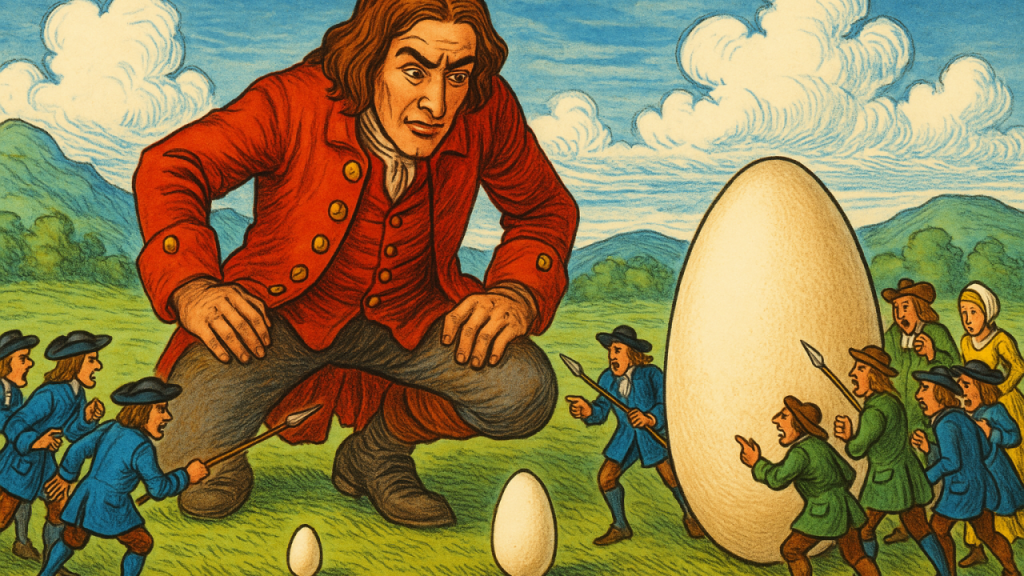
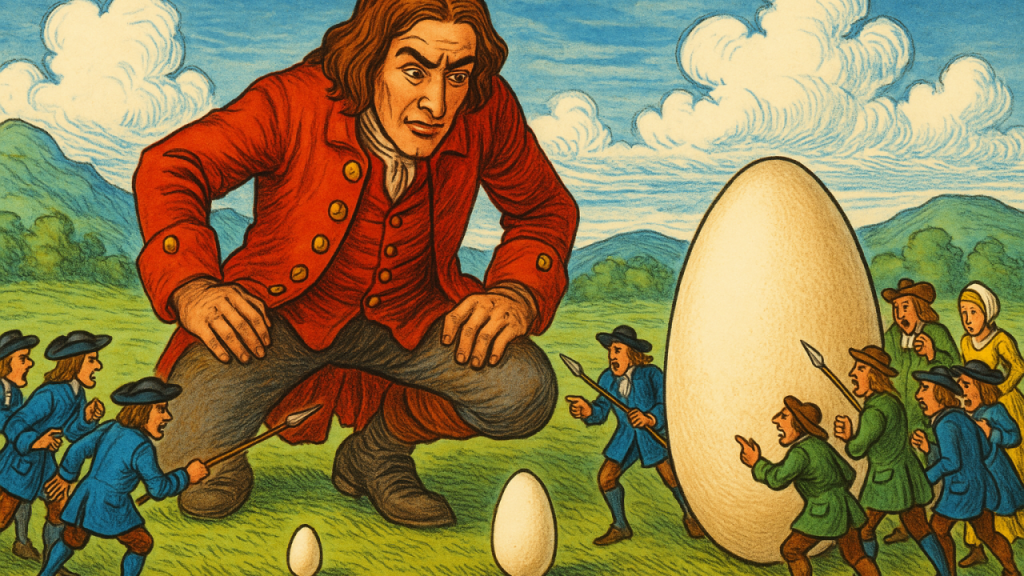
But Pastor Swift’s most famous work of jesting is his Gulliver’s Travels. In one of Gulliver’s adventures, he travels to the land of the Lilliputions. There he discovers that these six inches tall little people have suffered much bloodshed in their continual war between the Big Ender and Little Ender factions. When inquiring as to what this dispute is about, Gulliver discovers that it has to do with which end to crack an egg from. The little enders arguing the little end and the big enders arguing the big end.[2] Now, you’d think a solution could be to just crack the egg down the middle. Really!? We’d just end up with Big Enders, Little Enders and Middlers at war with each other.
We laugh at the ridiculousness of all this, until, like Jester Nathan does with David and says, “You are the man,” we discover that Swift wasn’t talking about eggs, but of all our trivial debates in the religious wars that plagued Europe for over a century after the Reformation. Catholics vs Protestants. High church vs Low church. Reformation vs Radical Reformation. Often with each side being ignorant of what the other believed. We are called Lilliputions for a reason. For, despite our certainty and arrogance, we are small, and small minded, considering eternity.
Gulliver’s Travels is dripping with this kind of material, and it’s as relevant today as when it was written. To neglect these works is to deprive the preacher of great sermon fodder that is creative, imaginative and full of pictorial insights which disturb people’s minds long afterwards, as did Jesus’ parables, much more than precepts do. We can learn a lot from these Ministry Jesters.
Erasmus’ In Praise of Folly (1509) is another significant work in this line. A work that, after enjoying its’ hilarity, the Catholic Church put on the Index of Forbidden Books, when they realized it was poking fun at them.[3]Jesting should be one of the tools in the preacher’s tool belt. Especially when we see it used throughout church history and with many of the Biblical prophets.
Not all preaching has to hit you in the face right away. There is something brilliant, strategic, subtle, and funny with a subversive approach that causes people to, a few hours later, sit up and suddenly discover, “Hey, he was talking about me!”
But by that time, the Jester has already exited stage left.
[1] Interestingly, James William Johnson argues that “A Modest Proposal” was influenced by the work of another Ministry Jester by the name of Tertullian, who lived in the third century, and whose Apology is a satirical attack against the Romans for their persecution of Christians.
[2] I realise this sentence is a bit insulting to your intelligence.
[3]Sounding a lot like what Swift was pointing out with the egg crackers, hear Erasmus’ Folly speak:
“Listen to our great and illuminated theologians, as the world calls them! Arguing as whether it be a possible proposition that…. God the Father hates the Son; or whether it was possible that Christ could have taken upon Him the likeness of a woman, or of the devil, or of an ass, or of a stone, or of a gourd; and then how that gourd should have preached, wrought miracles, or been hung on the cross…. There are infinite of these subtle trifles, and others more subtle than these, of notions, relations, instants, formalities, quiddities, haecceities, which no one can perceive without a Lynceus whose eyes could look through a stone wall and discover those things through the thickest darkness that never were.”
 Stef Piva
Leave a comment