On Farting Boggarts
I ended my last blog with the following quote from the jesting Martin Luther:
“Almost every night when I wake up the devil is there and wants to argue with me. I have come to this conclusion: When the argument that the Christian is without the law and above the law doesn’t help, I instantly chase him away with a fart.” (LW 54:78).
Lines like this are frequent in the works of Luther. His Table Talk is full of humor, as well as some rather crude imagery.[1] But lines like the one above were not just Luther trying to be crude or funny. Instead, Luther was making an important theological statement. The Devil, as well as all our anxieties, operates in the realm of fear. And when we fear something it has power over us.
Now, of course, some things should be feared. I rightly fear falling off a 100 foot cliff because of the impact this fall will have over my mortal body. But what Luther was reminding us of, on those restless nights of insomnia where he battled the dark thoughts in his mind, was that the Devil is defeated. The cross and resurrection of Christ has stripped the Devil of all of his power and claim over our life. But because our brains can be tricky things, Luther understood that logically repeating this truth to the devil doesn’t always seem to stop the downward spiral of our thoughts. So the other way out is to use humor and mockery. Luther understood the psychological power there comes in laughing at our unreasonable fears.
In the Harry Potter series J.K. Rowling brings this to life in one of the classes on “Defense Against the Dark Arts” where they learn how to fight a Boggart. The Boggart is a shape-shifting creature that transforms itself into its observer’s greatest fear. So, when the Boggart is released, Ron sees a giant spider and Neville sees Professor Snape. How the Boggart is defeated is by pointing your wand at it, saying, “Riddikulus” and laughing at it. When this is done, Ron’s “spider” sprouts rollerskates and falls all over the place and Neville’s “Snape” appears in his grandmother’s flowery dress. Laughter took away the object’s power.
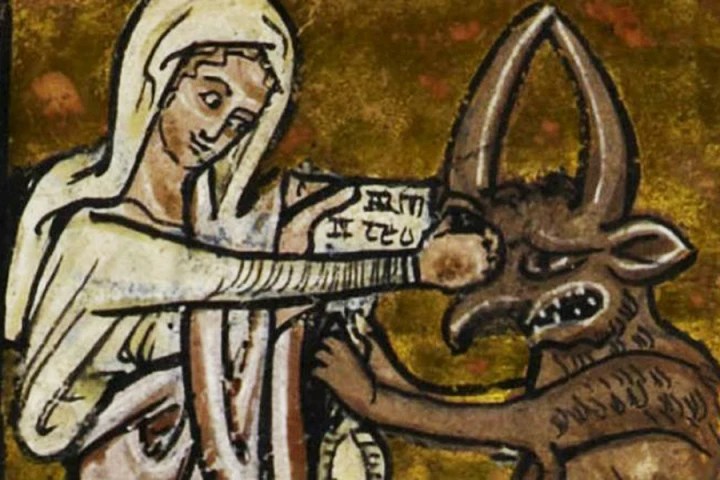
This was one of the things that happened in some of the medieval morality plays and Carnival. When the devil character walked on stage people, including the children, knew to boo and laugh. This was a way to ease their fears and to remind themselves not to be afraid. The devil was a conquered foe. Jesus had rendered him riddikulus. As Hans Rudolf Velten writes in his scholarly chapter on the subject:
Council records and carnival plays highlight the depowering of a devil’s force: when, in secular plays, he is shown as akin to foolish peasants; when he appears as inferior to ugly old women, beaten both physically and intellectually; and when he becomes a laughing-stock who is no longer dangerous to anyone, there is no pagan fear of him left.[2]
C.S. Lewis reveals this same intent in writing the Screwtape Letters by including the following quote by Thomas More on the front page (next to a Luther quote), “The devil… the proud spirit… cannot endure being mocked.”
On one of my trips to Cameroon I witnessed the fear the Ju Ju (witchdoctors) continue to inflict upon many of the people in the remote villages. Dressed up in scary costumes and dancing and gyrating under the influence of drugs and alcohol, the villagers fall to the ground before them and try to avoid eye-contact. But the only thing giving half a dozen Ju Ju power over an entire village of people is fear. If the Ju Ju came to town and the entire village stood there and laughed at them, or, in the tradition of Luther, farted at them, that would be it for the Ju Ju. They’d become a cultural relic that nobody takes seriously anymore.
I think about this in relation to my own fears. I’m certainly prone to anxiety and downward spiral thinking towards the Ju Ju devils in my life. Imposter syndrome. Failure. Needles. Anxiety that I’ll get anxious. Even irrational chest pain anxiety around public speaking. And I’ve done it thousands of times. Frustrating.
Certainly, I pray. I remind myself of who I am in Christ. I use cognitive behavioural therapy. I even use medication when I need to. You’d think that would be enough. But sometimes, the problem with all of those things is that they are too serious. The devil and anxiety are irrational. Logic and truth don’t always work when dealing with something irrational. Not because the truth isn’t true, but because the battle is happening on another front. Most bullies are too dense to be reasoned with, but you can laugh at them. You can refuse to take them seriously. For the bully, that’s the most infuriating thing imaginable, because, without your fear, they no longer have any power over you. So, when dealing with the irrational, often the best solution is to recognize it’s Riddikulus and to laugh, and fart, at it. So, one of the best ways to release some anxiety can be to release some gas! Not to mention that it’s one of the cheapest forms of therapy you will ever find.
[1] I’ll leave Table Talk 5537 for you to look up on your own to see how Luther could take his analogies a little too far. Definitely not a Luther quote you want to use in your next sermon.
[2] There is certainly more nuance and debate in understanding the role of the devil in Medieval Theatre, but this was certainly one of them. See Hans Rudolf Velten, “Devils On and Off Stage: Shifting Effects of Fear and Laughter in Late Medieval and Early Modern German Urban Theatre”. https://www.jstor.org/stable/10.1163/j.ctt1w76w7w.15?seq=1
 Stef Piva
Leave a comment